SA Heat Exchange designs and manufactures custom heat exchanger solutions, thermally engineered to deliver lasting performance in your process / plant.
20 years serving Africa’s largest industrial clients.
Since 2007, SA Heat Exchange has delivered engineered heat transfer solutions across Africa. Our strength lies in combining advanced thermal and process design with extensive in-house engineering and manufacturing capabilities.
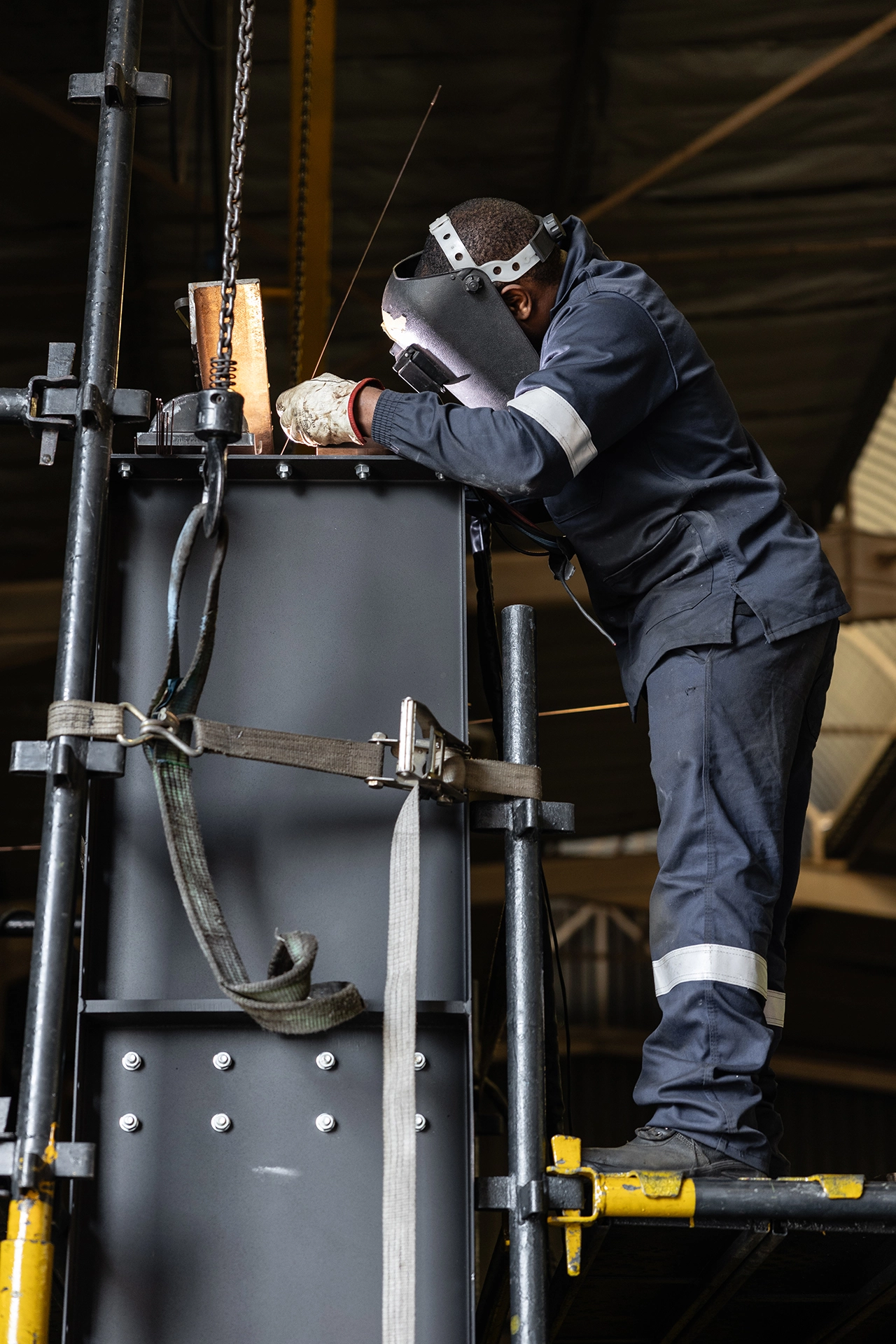
From concept and thermal design through precision fabrication, quality control and pressure testing, we manage the complete heat exchanger process under one roof.
Our portfolio includes patented BLOCKFIN air blast heat exchangers and TRANSON modular shell and tube technology, alongside conventional shell and tube and gasketed plate heat exchangers. All backed by an ISO 3834-certified manufacturing facility and rigorous quality management processes.
Our core capabilities:
We design and manufacture heat exchangers for demanding industrial processes, delivering engineered heating and cooling solutions across a wide range of applications.
Select an industry to explore how our solutions support its processes and applications.
Explore our comprehensive range of heat exchangers, engineered and manufactured to meet demanding industrial requirements.
Not sure which solution is right for your application? Our design engineers will assess your process requirements and select the right solution.
Air blast coolers and heaters, including our mechanically finned BLOCKFIN range. For air driers, compressor coolers, steam air heaters and gas cooling.
Up to 450 °C · Carbon & stainless · Custom sizes
Fixed tube sheet, U-tube and floating bundle units, plus TRANSON, the modular shell and tube we build as the OEM. For oil coolers, water heaters and condensers.
Up to 600 °C · High pressure · Wide material range
Gasketed, brazed, spiral and welded plate heat exchangers. Design and sizing of custom SA Heat Exchange plate heat exchangers. In addition to gasket and plate spares for over 400 models from Alfa Laval, APV, GEA, Sondex and others.
Up to 250 °C · Compact design · Easy maintenance
From process and thermal design to specialised manufacturing, inspection and maintenance, SA Heat Exchange delivers comprehensive engineering services across a wide range of heat exchanger technologies.
In-house thermal design, process engineering and fabrication, tailored to your operating requirements or replicated from existing equipment and specifications.
Specialist assessment, servicing and refurbishment, including retubing, welding, brazing, gasket replacement and pressure testing.
In-house thermal and process design expertise, delivering solutions engineered around your specific operating requirements.
From design and fabrication to tube finning, welding, brazing, CNC machining and non-destructive testing, our capabilities are integrated under one roof.
Patented BLOCKFIN and TRANSON technologies, developed for demanding industrial environments and backed by decades of proven performance.
Rigorous quality control throughout every stage of production, ISO 3834-certified manufacturing, and B-BBEE Level 2 Contributor.
Can’t see your question? Call the workshop on (031) 811 0061.
An industrial heat exchanger moves heat from one fluid to another, liquid or gas, without the two mixing. Plants use them to heat, cool or hold a process at temperature, which saves energy and protects equipment. The three main types are finned tube, shell and tube, and plate.

Send us your process details and we do the selection. We need the heat load in kW, inlet and outlet temperatures on both sides, operating pressures, the fluids and how dirty or corrosive they are, the space available, site conditions and any design code you must meet.
Mostly copper, aluminium, stainless steel and carbon steel. Copper and aluminium transfer heat well and suit water and air applications. Stainless steel resists corrosion and meets food-grade hygiene. Carbon steel handles high temperatures and pressures, especially on steam. We pick the material to suit your fluids and site.
Regular visual checks for leaks and corrosion, monitoring temperatures and pressure drop, cleaning before fouling builds up, periodic hydrostatic testing and replacing gaskets and seals when due. How often depends on the type and how hard it works. Our repair division can set a schedule and do the work.